Associated Degree
Educational Objectives
Educational Objectives of the Financial Technology Major are:
- Key technologies of the FinTech industry, including artificial intelligence (AI) & machine learning (ML) & natural language processing (NPL), blockchain & cryptocurrency, and smart contracts.
- Relevant programming skills.
- Recent innovations in the financial services industry, including payment, credit, capital markets, insurance, and real estate.
- The limitations and challenges of FinTech (e.g., inclusion, regulation).
- Emerging areas for entrepreneurial opportunities in the FinTech sector
- The operational and strategic goals of financial institutions and intermediaries, and how technology is reshaping not only the traditional areas of finance (e.g., alternative lending ("alt- finance")) and wealth management but also in related fields such as insurance ("Insur-tech") and real estate.
- The information and communication tools, technologies, and standards integral to consumer, merchant, and enterprise services in the payments and financial service sectors. These technologies span messaging, communication networks and gateways, core processing, mobile and online software, and application program interfaces (APIs).
- The basic legal frameworks of the U.S. banking and securities sectors, how new technologies ("FinTech") are transforming legacy banking and securities business models, and how new information technologies may be able to deliver financial services to communities historically excluded from the banking and/or securities sectors.
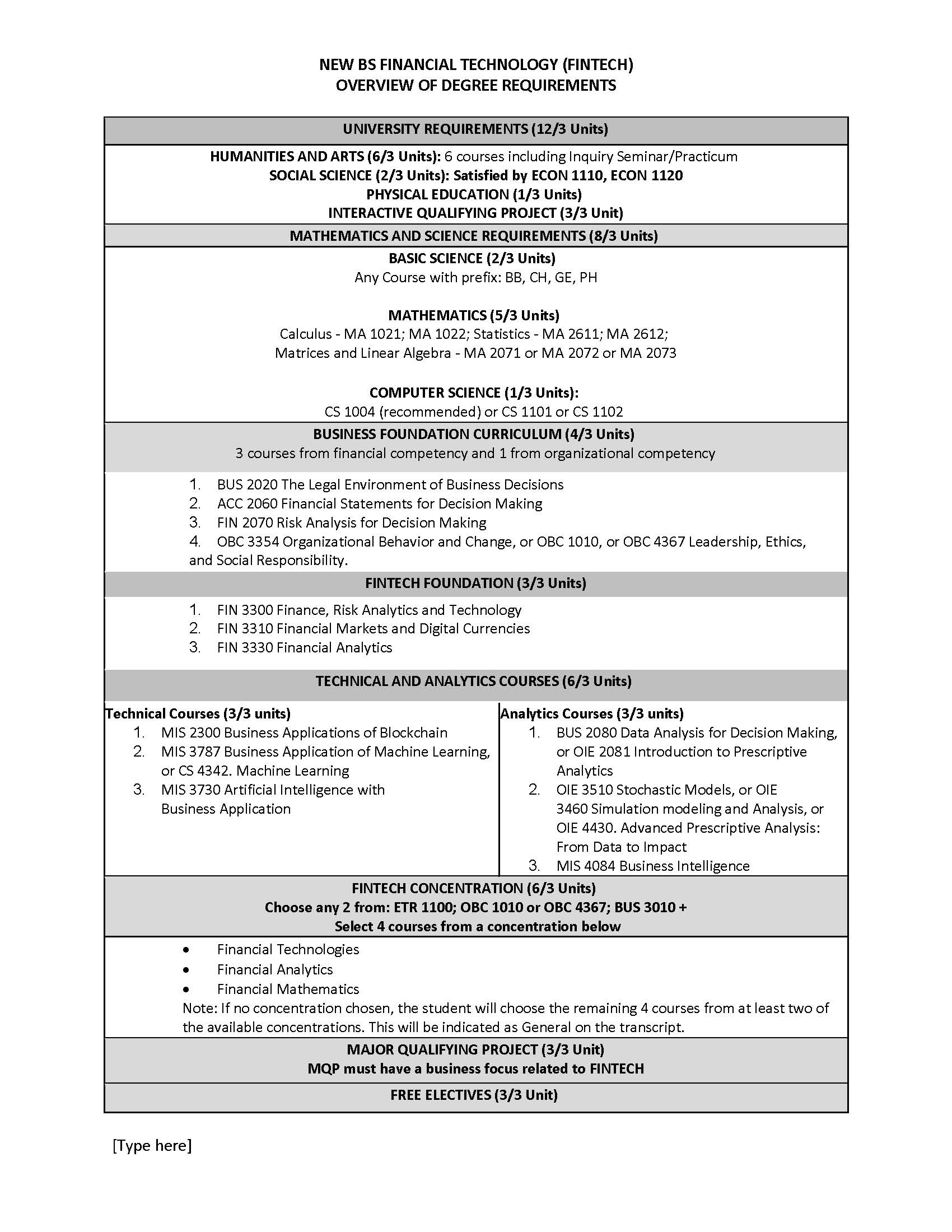
Program Distribution Requirements for the FinTech Major
Item #
Title
Units
1/3
1/3
MA 2071 or MA 2072 or MA 2073
1/3
1/3
Minimum Units
5/3
Item #
Title
Units
Minimum Units
1/3
Minimum Units
2/3
Item #
Title
Units
1/3
1/3
Minimum Units
2/3
FinTech Courses
Item #
Title
Units
1/3
1/3
1/3
OBC 1010 or OBC 3354 or OBC 4367
Minimum Units
4/3
Item #
Title
Units
1/3
1/3
Minimum Units
3/3
Item #
Title
Units
1/3
1/3
MIS 3787 or CS 4342
Minimum Units
3/3
Item #
Title
Units
1/3
OIE 3460 or OIE 3510 or OIE 4430
Minimum Units
3/3
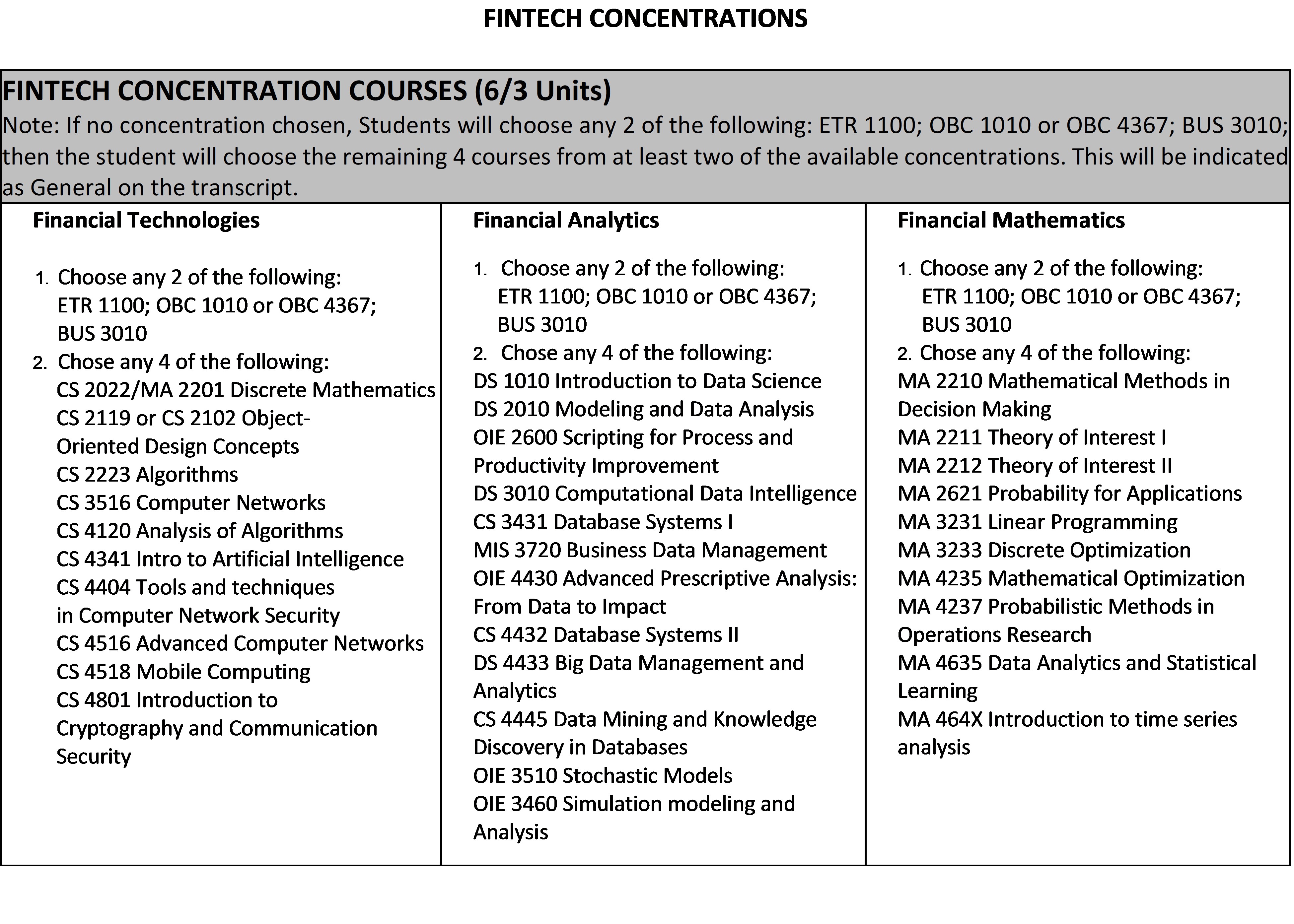
Financial Technologies Concentration Courses (6/3)
Item #
Title
Units
Select two from: ETR 1100, MIS 3010, 0BC 1010 or OBC 4367
1/3
1/3
1/3
1/3
Minimum Units
2/3
Item #
Title
Units
1/3
1/3
1/3
1/3
1/3
1/3
1/3
1/3
1/3
Minimum Units
4/3
Major Qualifying Project (3/3 units)
MQP must have a business focus related to FinTech.
Free Electives (3/3 units)
Program Chart and/or Course Flow Chart