Associated Degree
Educational Objectives
Objectives of the Management Engineering Major are:
- To prepare students for management challenges in key areas that increasingly require proficiency in the technical aspects of business such as production and service operations.
- To provide the knowledge and skills necessary to succeed professionally, including literacy in a technical field, a broad understanding of management issues, written communication, oral presentation, decision-making, and leadership skills required to create new and improved products, processes and control systems.
- To develop student abilities necessary for continued career growth including:
- the ability to integrate theory and practice and to apply knowledge of technical issues with the foundations of management
- the ability to integrate technology and change into existing organizations
- the ability to think critically and analytically, to define and solve business problems, work in teams, and think globally; and
- the ability to learn new skills in response to changing professional requirements.
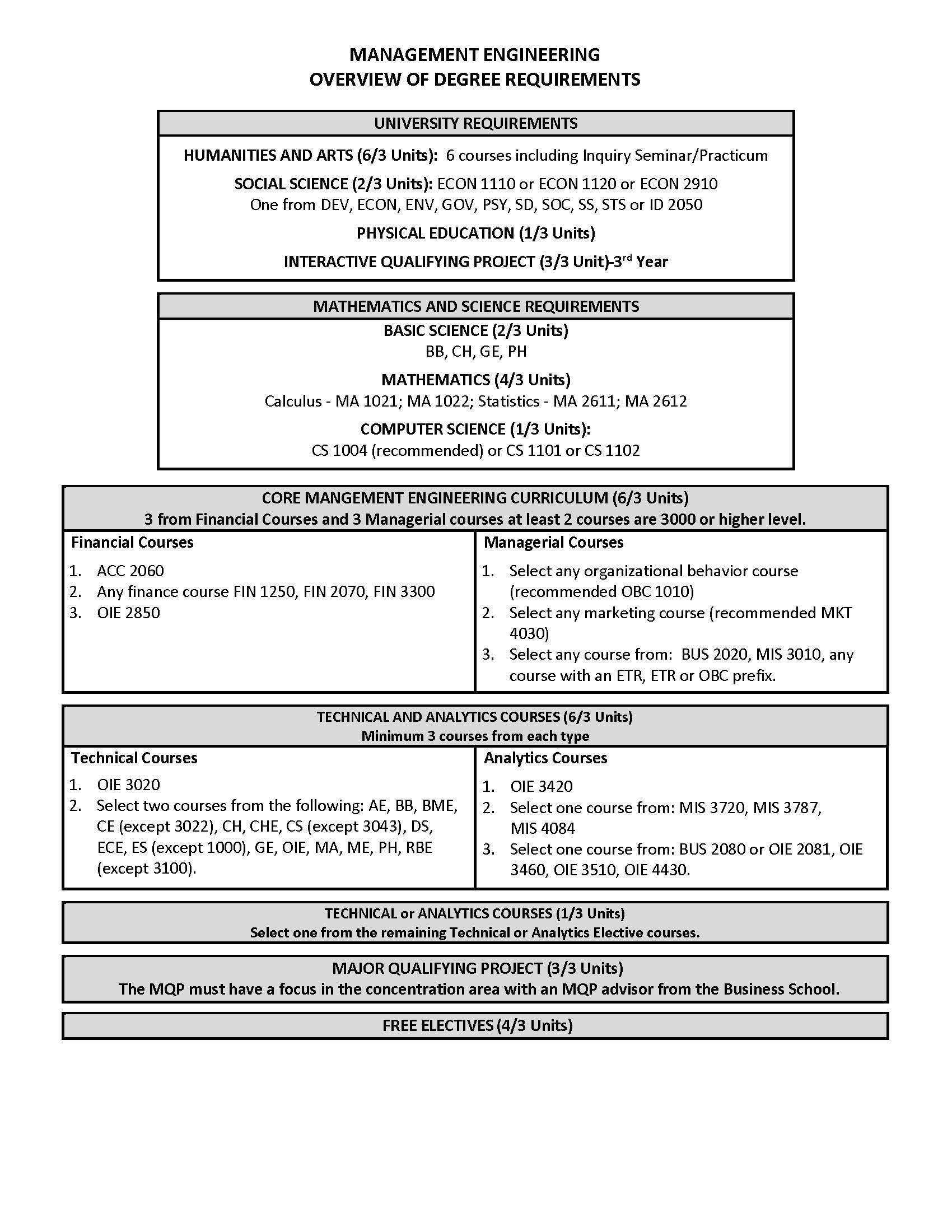
Program Distribution Requirements for the Management Engineering Major
Mathematics and Science
Item #
Title
Units
1/3
1/3
1/3
1/3
Minimum Units
4/3
Item #
Title
Units
1/3
1/3
1/3
Minimum Units
1/3
Minimum Units
2/3
Item #
Title
Units
1/3
1/3
Minimum Units
2/3
Management Engineering Core Curriculum
Item #
Title
Units
1/3
1/3
Minimum Units
3/3
Item #
Title
Units
1/3
1/3
1/3
Minimum Units
3/3
Item #
Title
Units
1/3
1/3
Minimum Units
3/3
Minimum Units
1/3
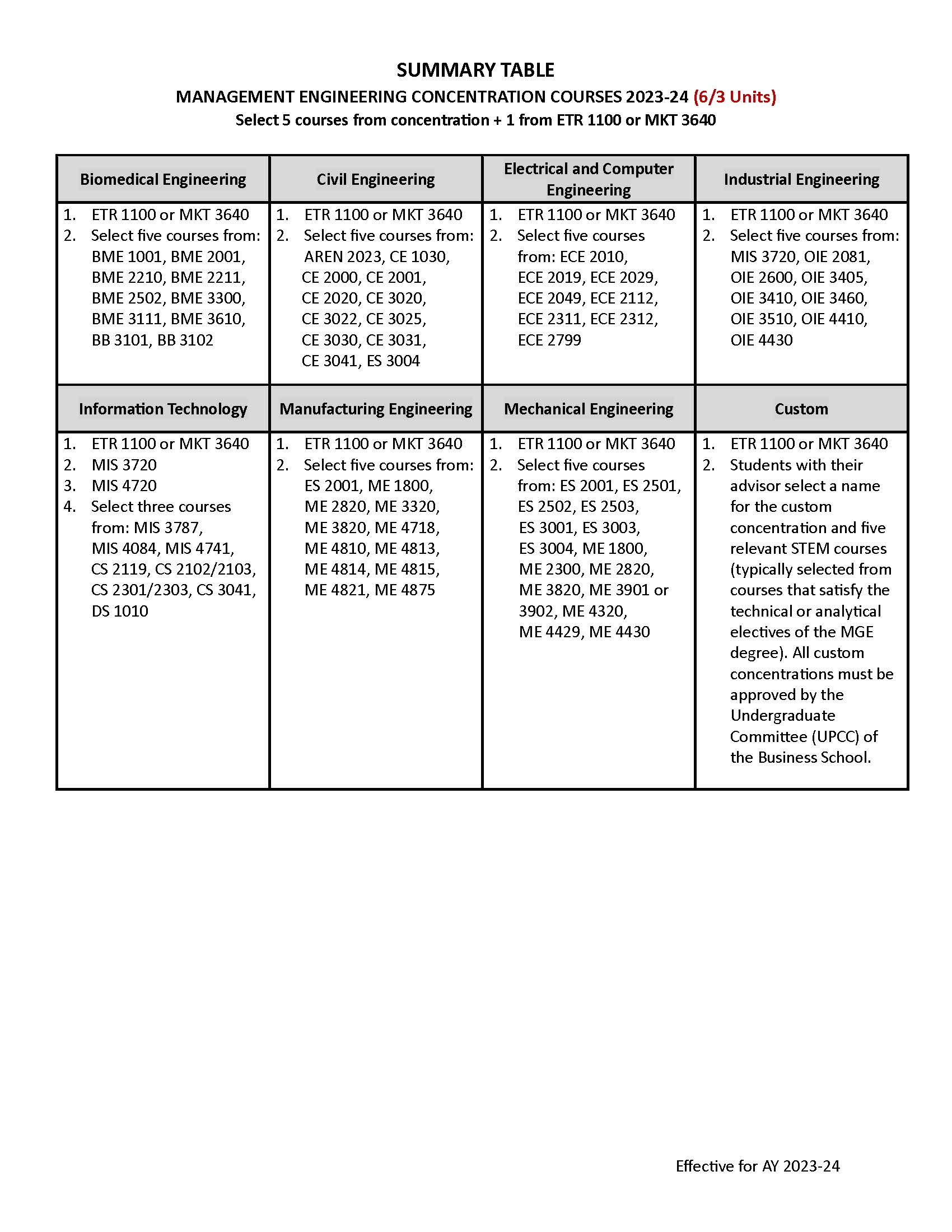
Management Engineering Concentration Courses (6/3 Units)
Students selecting the Management Engineering Major must complete six courses from one of the concentrations as specified in the summary table for concentrations. Students may also work with their faculty advisor to create a custom MGE Program. Such custom programs must be approved by the advisor and the Business School’s Undergraduate Policy and Curriculum Committee.
Item #
Title
Units
1/3
1/3
1/3
1/3
1/3
1/3
1/3
1/3
1/3
1/3
1/3
Minimum Units
6/3
Minimum Units
3/3
Minimum Units
4/3
Program Chart and/or Course Flow Chart