Program Mission
The mission of the Industrial Engineering (IE) Program at WPI is to prepare undergraduate students for professional engineering practice, providing the foundation for careers of leadership in challenging global and technological environments. We strive to accomplish this through:
- An innovative, project-based curriculum
- An emphasis on industrial engineering skills with system applications
- A flexible curriculum responsive to student interests and changes in the competitive environment
- An environment that encourages faculty/student interaction
- A culture that encourages the active involvement of students in their learning
Program Educational Objectives
Within a few years after graduation, IE Program graduates are expected to:
- Apply their industrial engineering, systems thinking, modeling and design skills to support operational and strategic decision-making in complex and changing environments through problem definition, solution design, and implementation, using current and emerging concepts and technologies.
- Serve as change agents and leaders in a global environment, leveraging strong communication, project management, and multidisciplinary teamwork skills grounded in professional and ethical responsibility.
- Grow their skills and knowledge to take on new professional challenges
Student Outcomes
Specifically, graduating students should demonstrate that they attain the following:
- an ability to identify, formulate, and solve complex engineering problems by applying principles of engineering, science, and mathematics
- an ability to apply engineering design to produce solutions that meet specified needs with consideration of public health, safety, and welfare, as well as global, cultural, social, environmental, and economic factors
- an ability to communicate effectively with a range of audiences
- an ability to recognize ethical and professional responsibilities in engineering situations and make informed judgments, which must consider the impact of engineering solutions in global, economic, environmental, and societal contexts
- an ability to function effectively on a team whose members together provide leadership, create a collaborative and inclusive environment, establish goals, plan tasks, and meet objectives
- an ability to develop and conduct appropriate experimentation, analyze and interpret data, and use engineering judgment to draw conclusions
- an ability to acquire and apply new knowledge as needed, using appropriate learning strategies.
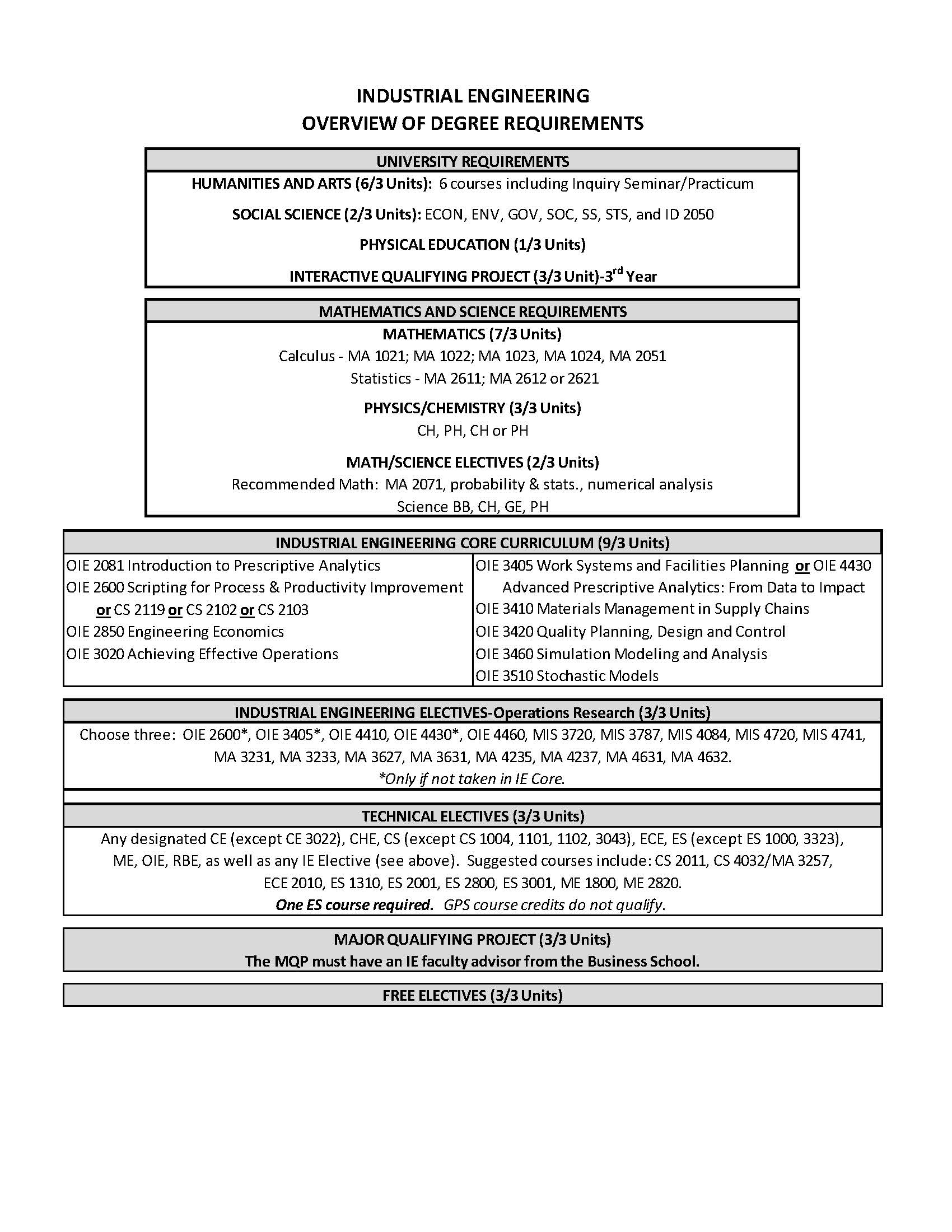
Program Distribution Requirements for the Industrial Engineering Major
The normal period of residency at WPI is 16 terms. In addition to the WPI requirements applicable to all students (see page 7), students wishing to receive the ABET accredited degree designated “Industrial Engineering” must complete a minimum of 10 units of study in the areas of mathematics, basic science, and engineering topics as follows:
Mathematics and Science Requirements
No GPS credits may be used.
Physics/Chemistry (3/3 Units)
One Chemistry course and one Physics course required; plus one additional Chemistry or Physics course.
Math and Science electives (2/3 units)
Recommended Math: MA 2071, probability & statistics, numerical analysis.
Recommended Science: BB, CH, GE, PH
One from DEV, ECON, ENV, GOV, PSY, SD, SOC, SS, STS
Industrial Engineering Topics (15/3 units)
Industrial Engineering Topics must include courses in the following three topic areas